

The fastest-growing AI talent in banking isn’t in engineering

Learning Adviser
xUnlocked Learning Team
What the 2026 Evident AI Index reveals about AI enablement, and how banks can turn AI use into measurable results.
Banks first concentrated AI deployment among their most technical users. They are now extending it to the wider workforce through copilots and enterprise assistants, and employees across the business are finding where AI can remove friction and improve decisions.
Turning that use into results is the hard part. According to the Evident AI Index, the industry benchmark of AI maturity across 50 of the largest banks globally, only 12% of AI use cases are reported with an operational KPI, and barely 1% with a direct financial result. The top ten banks do better: they account for a quarter of use cases with a reported impact, but half of those with a direct financial result.
That is where the focus is shifting. Evident's 2026 methodology now counts AI enablement as a talent area and scores whether employees actually take up AI training. So how do you lead AI enablement in a way that proves results in your business and shows up as progress in the Index? Below, we look at what separates the leaders and what it means for your workforce.
Key takeaways
- Talent decides the ranking. It carries 45% of the score and tracks overall rank more closely than any other pillar.
- Enablers are now the fastest-growing AI talent. AI Enablement headcount grew 21.2% in a year; AI Development grew 1.9%.
- Training only counts if people use it. Evident now scores the uptake of AI training, not just whether a programme exists.
How does the Evident AI Index work?
The Evident AI Index ranks 50 of the largest banks in North America, Europe and Asia on AI maturity. It uses only public data, so every bank is judged the same way, from the outside in. Each bank is scored on four pillars:
- Talent (45%): how many AI and data specialists a bank employs, across six areas from AI Development to AI Enablement, and how it develops and upskills the wider workforce.
- Innovation (30%): AI research and patents, investments in AI companies, and open-source activity.
- Leadership (15%): the bank's AI narrative, its executive team's focus on AI, and the outcomes and returns it reports.
- Transparency (10%): how openly the bank shows its responsible AI work, from dedicated talent to governance and controls.
What moves a bank up the Evident AI Index?
Talent carries the most weight, and it also tracks overall rank most closely. When we compared each bank's overall rank with its rank on each pillar, the Talent ranking was the closest match. Leadership is the outlier: it carries more weight than Transparency, yet matches overall rank least closely.
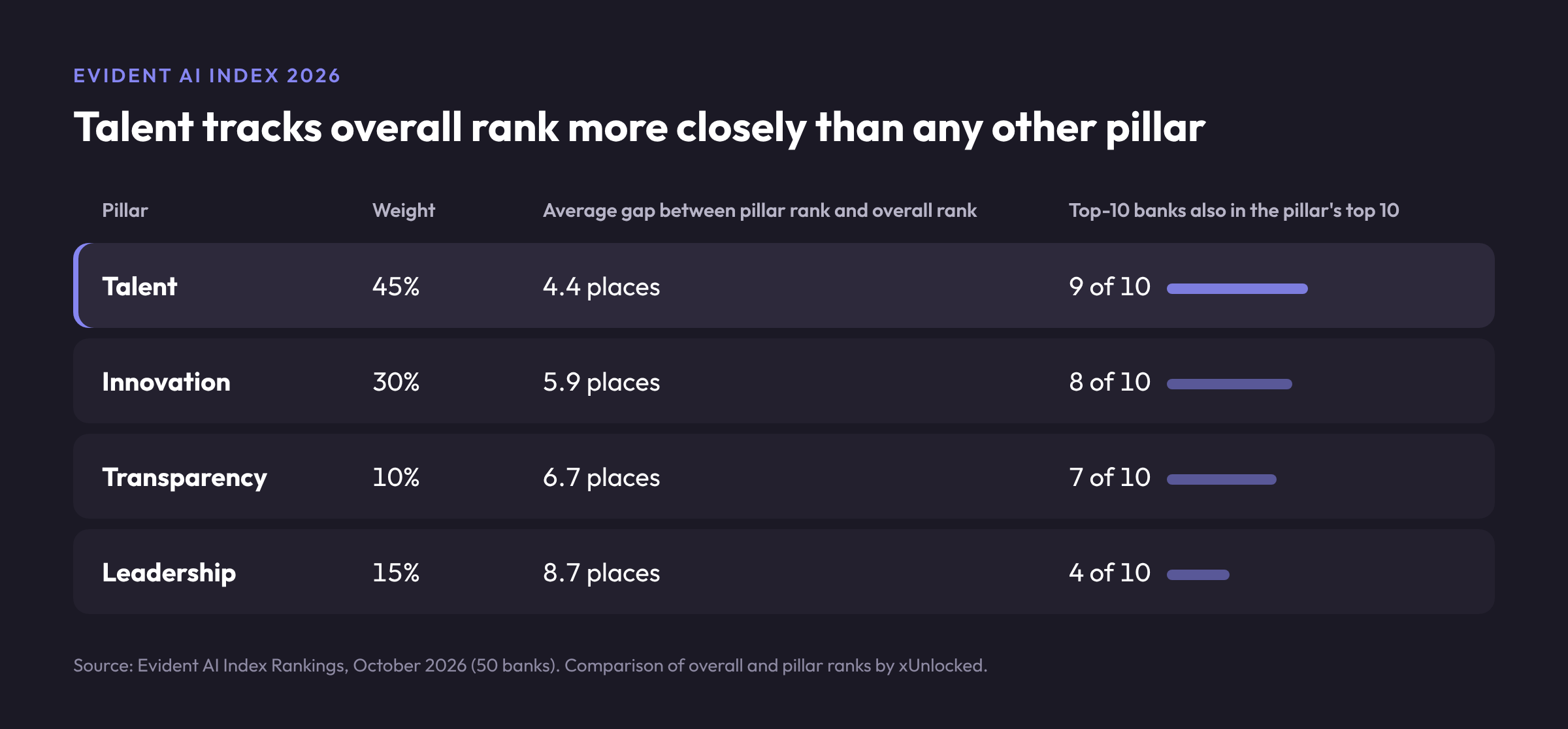
Capital One is second overall but 40th for Leadership; Citigroup is eighth overall and 42nd. Both are top five for Talent. The banks that lead invest in capability, both in specialist teams and across the wider workforce.
What changed in the 2026 Evident AI Index?
Evident changed what it counts as AI talent this year, in two ways that matter for workforce leaders:
- AI Enablement is now its own talent area. The people who help the business adopt AI count, not only those who build it.
- Training is scored on uptake. Having an AI training programme is no longer enough; the Index looks for evidence that people take it up.
The bar keeps rising. Evident is testing metrics for a fifth pillar, Outcomes, from 2027, so banks will need evidence of impact, not just activity.
What is AI enablement?
AI enablement is the work of helping a business adopt AI: identifying valuable use cases, redesigning workflows, driving adoption and moving AI safely into production. In banks, it is led by people who sit between technical teams and the business, such as AI champions, adoption leads and AI product managers.
AI literacy vs AI enablement
AI literacy is the baseline: every employee understanding what AI tools can and cannot do, how to use them safely, and when to apply their own judgement. For European banks it is also a legal duty. Article 4 of the EU AI Act has required organisations using AI to take measures to support staff AI literacy since 2 February 2025.
AI enablement builds on that baseline. Literacy gets people using AI; enablement makes that use count in the work.
Which AI roles are growing fastest in banks?
Across the 50 banks, Evident tracks around 127,000 AI and data employees. Growth is no longer led by engineers:
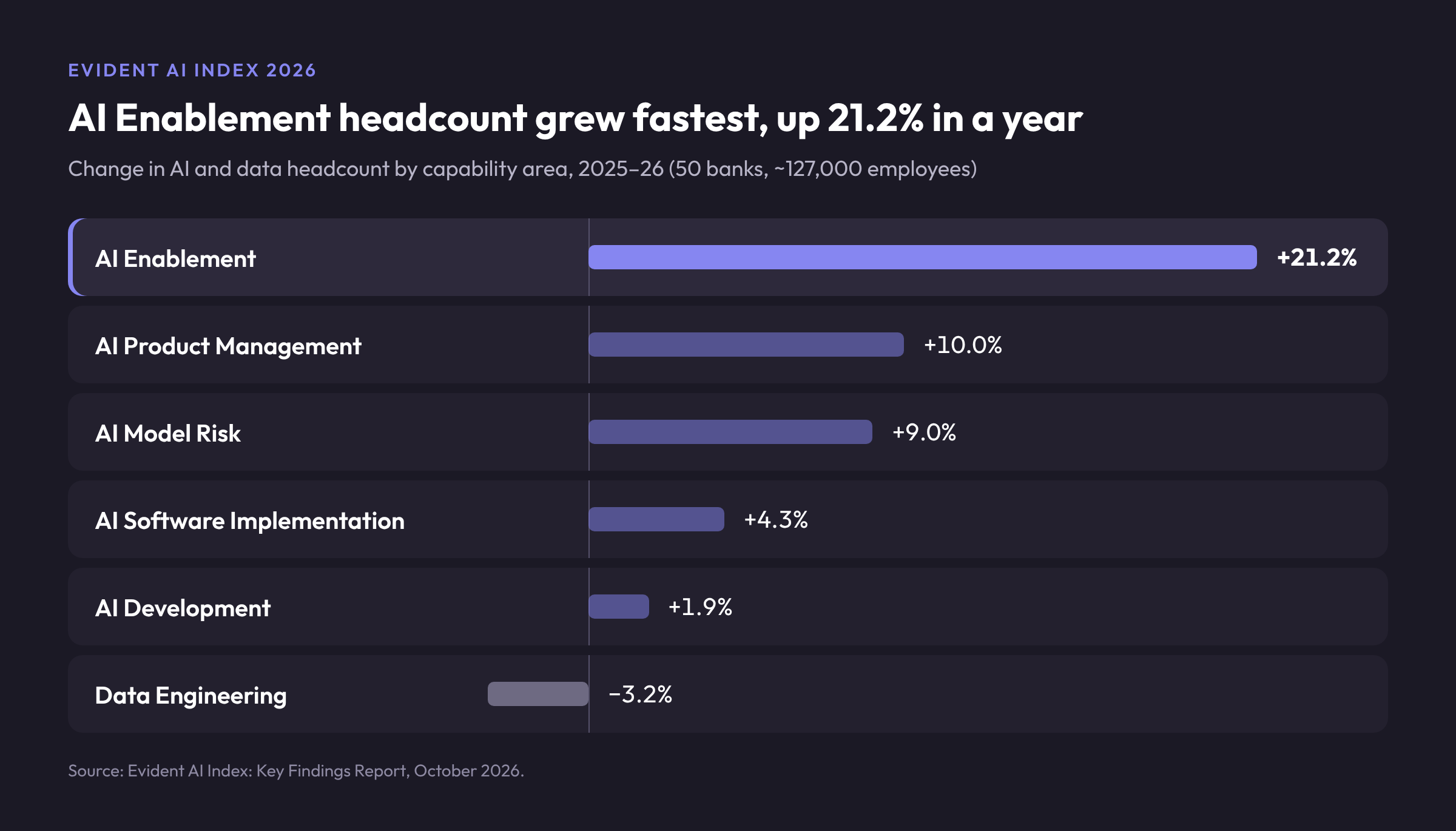
AI Enablement headcount grew 21.2%, AI Product Management 10.0%, AI Model Risk 9.0%, AI Software Implementation 4.3% and AI Development 1.9%, while Data Engineering fell 3.2%. Evident describes the fastest-growing roles as those "sitting between technical capability and the business". Engineers still matter: among the ten banks adding the most AI talent, AI Development makes up 35% of new hires and Enablement 28%.
How do banks measure AI adoption?
Leading banks measure AI adoption in layers: who has access, who uses it regularly, how work changes, and what that delivers. Most can report the first two; far fewer reach the last.
TD and Citi show what strong usage data looks like. At TD, 48,651 employees have access to Microsoft Copilot, about half the workforce, and 51% of them use it daily; TD measured about 350,000 hours of Copilot assistance in a single month. At Citi, 182,000 employees can use AI tools and more than 70% use them regularly.
Usage is not yet impact. Evident sorts reported impact into three levels: baseline metrics (reach, speed or volume), operational KPIs (efficiency gains, resolution rates) and direct financial results (cost savings, revenue uplift). Across the Index, most AI use cases never get past the first level.
Evident links the leaders' stronger results from productivity tools partly to "more robust training", alongside reusable prompts, data integration and ways to spread good practice. The gap between access and impact is, in large part, a people gap.
How do leading banks train employees in AI?
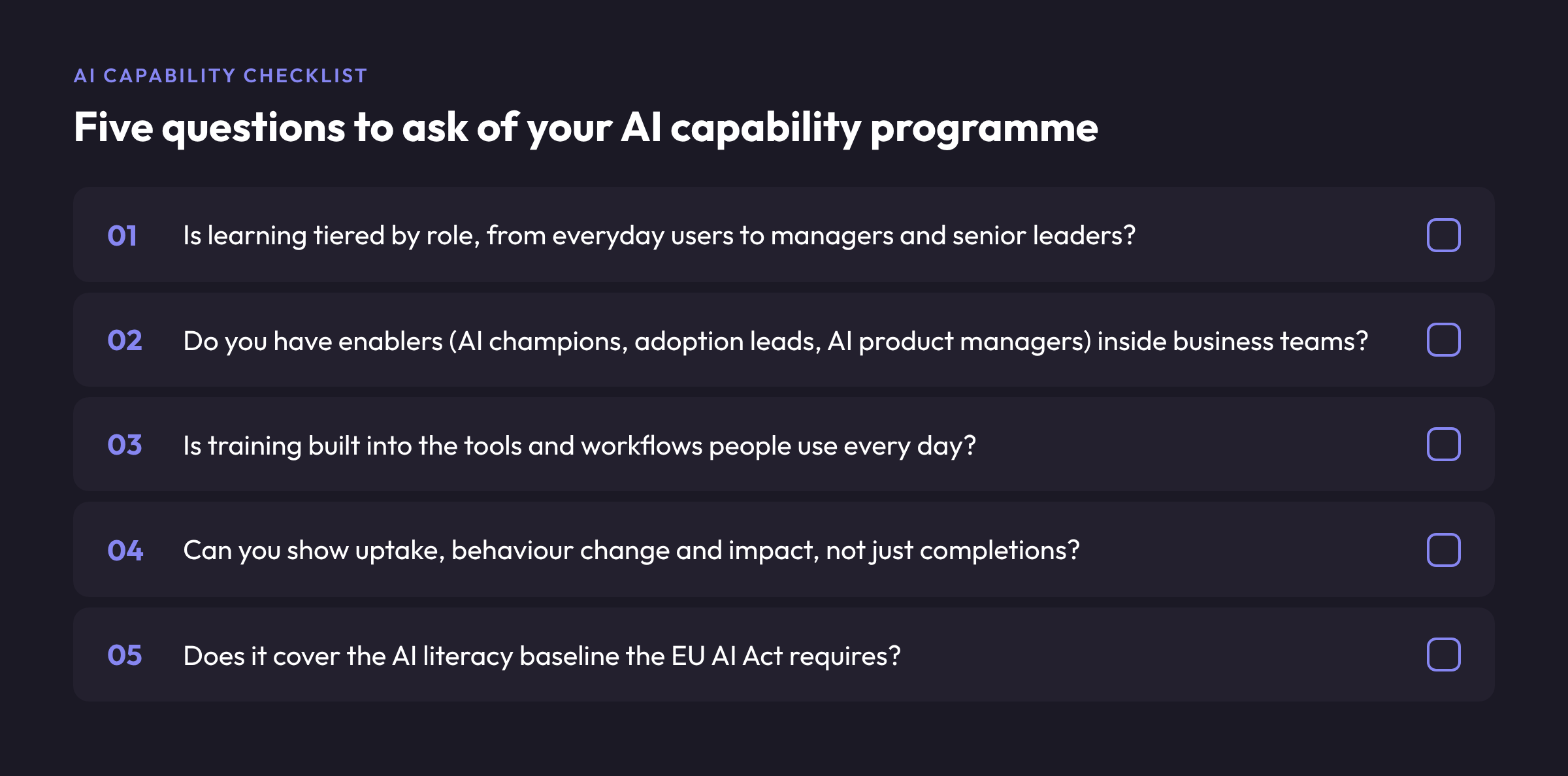
Leading banks train employees in tiers by role, tie training to the tools people use, and track uptake. They treat AI learning as infrastructure, not a one-off course:
- UBS runs three tiers: AI Citizens (20,000 employees), AI Enablers (98% of managers) and AI Senior Leaders (1,300 executives).
- Bank of America uses a role-based framework that moves from basic fluency to practical applications to advanced topics.
- Capital One launched an enterprise AI learning hub for more than 60,000 associates.
- TD pairs its rollouts with structured onboarding, office hours and training, which Evident describes as building "AI proficiency rather than simply distribute licenses".
How can banks move up the Evident AI Index?
By building workforce capability, the pillar with the most weight. The whole sector is moving faster: the average bank's score rose 26% this year, nearly three times the rate of previous years. But the top ten barely changed. Eight are headquartered in North America, UBS is the only European bank among them, and the highest-ranked UK bank, HSBC, is 11th.
Matching the leaders' technology budgets in one cycle isn't realistic. Building capability is. Lloyds Banking Group shows where to focus: it held 15th place overall but rose six places in Talent, to 10th, making it one of only two European banks in the Talent top ten, alongside UBS.
How xUnlocked helps
We work in three steps. Prepare: diagnose capability gaps with an AI maturity assessment and build buy-in. Perform: deploy learning into the daily workflow. Prove: validate competence and measure impact.
AI & Data Unlocked gives non-technical teams practical capability in GenAI, data literacy, AI governance and cyber resilience. It is designed by active market practitioners and CPD-accredited. It is also built for the uptake the Index now measures: in xUnlocked learner data, 89% of learners engage with the content and 90% actively apply what they learn in their daily workflows.
Our whitepaper, Judgement at scale: building AI-ready teams, sets out a 12-month blueprint for moving from AI access to applied capability. Download the whitepaper, or talk to us about diagnosing your AI capability gaps.

Frequently asked questions
What is the Evident AI Index?
An independent benchmark, published by Evident Insights, that ranks 50 of the largest banks in North America, Europe and Asia on AI maturity using public data.
How is the Evident AI Index scored?
On four pillars: Talent (45%), Innovation (30%), Leadership (15%) and Transparency (10%). Evident is testing a fifth pillar, Outcomes, for 2027.
Which banks lead the 2026 Evident AI Index?
JPMorganChase is first, followed by Capital One and Royal Bank of Canada. The top three have held their places since 2023, and eight of the top ten are headquartered in North America. UBS, in sixth place, is the highest-ranked European bank.
How can a bank move up the Evident AI Index?
Focus on Talent, which carries the most weight and tracks overall rank most closely. Grow AI enablement roles, run role-based training, track its uptake, and publish evidence of how AI is changing work.
What is the difference between AI literacy and AI enablement?
AI literacy is the baseline: employees understand what AI can do and how to use it safely. AI enablement turns that literacy into changed ways of working, through use cases, redesigned workflows and support for adoption.
Is AI training worth it for banks?
It pays off when it is tied to the tools people use and measured by uptake and impact. Evident links the leaders' stronger results from productivity tools partly to "more robust training", and the 2026 Index now scores training uptake directly.

Share "The fastest-growing AI talent in banking isn’t in engineering" on
Latest Insights


El Niño: Everyone is talking about it. But what does it actually mean for your business?
1st October 2026 • Maria Coronado Robles