

Prove: Making learning impact visible

xUnlocked
Learning programmes that have launched successfully, participation seems strong, and completion rates are reassuring as dashboards fill with activity and learners pass the assessments.
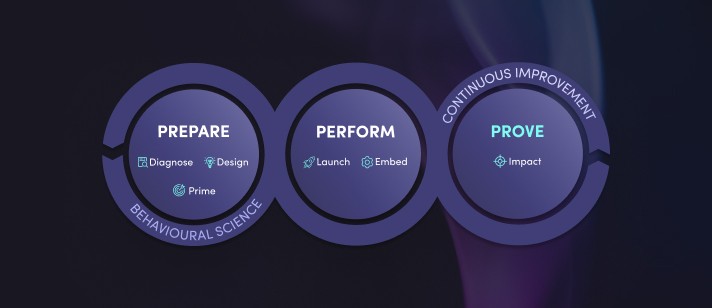
Over three pieces, we have explored the mechanics of effective learning in the context of 3Ps: Prepare, Perform and Prove.
- Prepare creates the conditions for successful learning.
- Perform turns trusted expertise into capability.
But there is a final challenge that every organisation must confront, particularly in environments where risk is high and scrutiny is constant: How do you know whether learning has actually changed anything?
This is the third, and critical pillar in learning: The ability to Prove the impact of your learning endeavour, demonstrating it has made a meaningful difference to behaviours and business performance.
For many organisations, this is also where certainty quickly fades. Learning programmes have launched successfully, participation seems strong, and completion rates are reassuring as dashboards fill with activity and learners pass the assessments.
And yet, beneath all the data, uncomfortable questions remain unanswered:
- Have people become better equipped to make decisions under pressure, navigate complexity, or respond more confidently to change?
- Has learning altered behaviour in ways that the business can actually feel?
- Has capability genuinely improved?
Too often, organisations struggle to answer these questions with confidence. Not because learning has failed, but because they are measuring the wrong things.
The cost of superficial measurement is growing for organisations operating under regulatory scrutiny, strategic pressure, and increasing accountability. Cybersecurity offers a stark reminder of the limitations of measuring learning through participation alone.
The cost of superficial measurement is growing for organisations operating under regulatory scrutiny, strategic pressure, and increasing accountability. Cybersecurity offers a stark reminder of the limitations of measuring learning through participation alone. Despite widespread awareness training, research shows that human error continues to play a significant role in security incidents, demonstrating that exposure to information is not the same as capability under pressure.
Leaders need confidence that learning has strengthened judgement, reduced risk, and improved the organisation’s ability to execute.
This is what we mean by Prove: making capability visible.
How do you measure the impact of learning?
At xUnlocked, we believe this requires a fundamental shift in how learning impact is understood. It needs to be recognised as the culmination of a journey, one that starts when organisations prepare the ground for learning designed to genuinely change how people think, decide and perform. And it extends right through to measuring and proving that the learning is, in fact, influencing how people think and act.
That level of proof needs sophisticated metrics that are embedded into the learning experience, and that can scale across enterprise learning platforms. It is an approach that enables organisations to look more closely at what learners are gaining, how their confidence is changing, and whether new knowledge is becoming something they can apply in the reality of their role.
Because it is a journey, rather than waiting until the end of a programme to assess success, we seek at xUnlocked to capture evidence continuously, at the moments where capability begins to take shape.
As learners progress through our learning modules, they are invited to reflect, not simply on whether they have engaged, but on whether their understanding has deepened, whether the learning feels relevant, and whether they feel more capable of applying it in practice.
These signals may seem simple, but they are profoundly important. They allow organisations to move from measuring activity to assessing progression, from beyond participation and content consumption, to real visibility around confidence and behavioural change.
How do we achieve this? Learning metrics that count
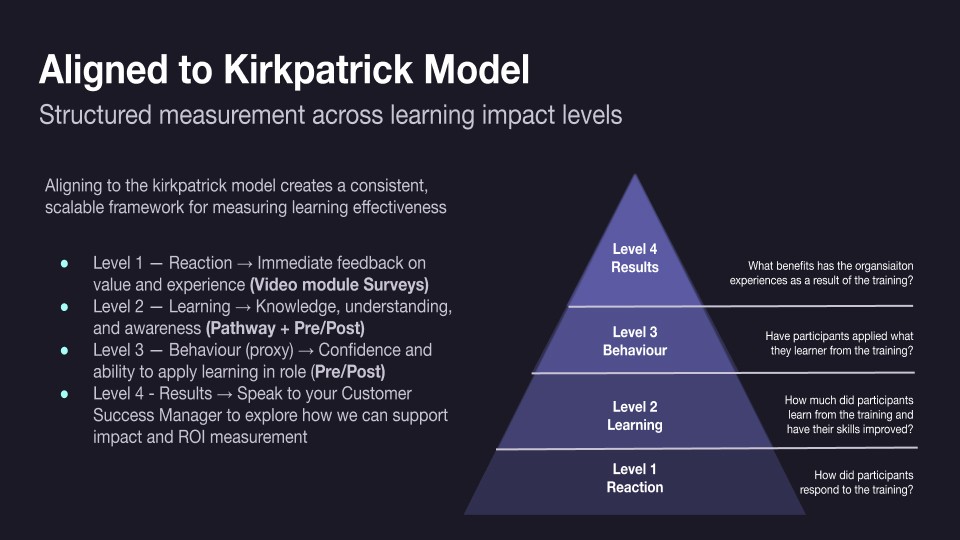
Our framework is aligned to the Kirkpatrick Model, long recognised as one of the most trusted and easily understood ways to evaluate learning effectiveness.
The use of Kirkpatrick is not academic, but practical. We use the model to create a consistent and scalable way for organisations to understand whether learning is generating value — not only in how learners respond, but in how they begin to apply what they have learned. It is, in other words, an important way to showcase value and ROI to the wider organisation, beyond the L&D function.
xUnlocked Impact Surveys, appearing as pop ups at key milestones, are also embedded in the natural flow of learning, allowing us to capture meaningful feedback as learners progress.
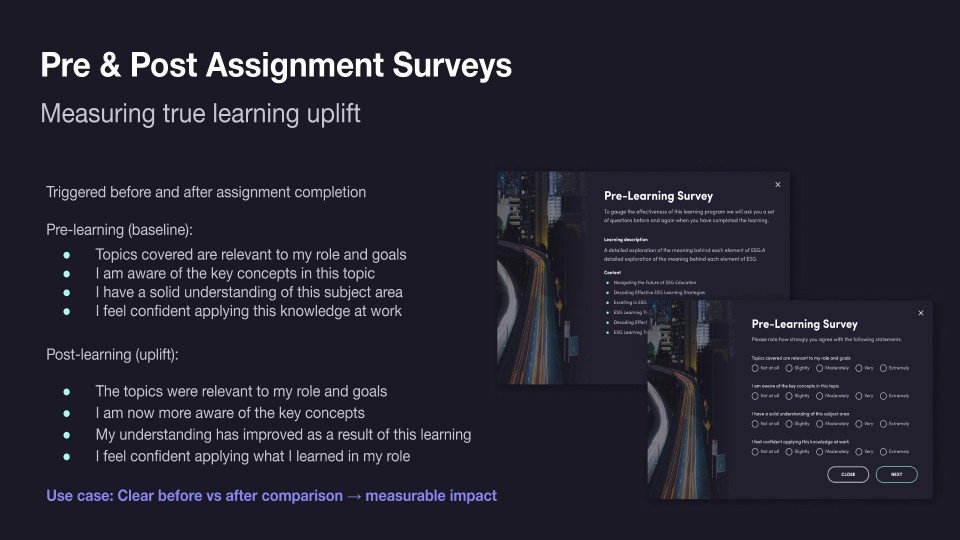
Across our learning programmes, learners consistently report meaningful increases in knowledge, stronger understanding of critical topics, and greater confidence in applying their learning in day-to-day decisions. According to recent findings from our Impact Surveys, 70% overall of learners report high learning impact (across video modules, Pathways and Assigned Learning):
- 76% of learners see immediate value at video module level.
- 72% of learners say knowledge has increased after a pathway.
- 67% report confidence in applying knowledge post-assignment.
These positive feedback scores are early indicators of capability becoming real. That matters because genuine capability typically appears first in quieter ways: a more confident conversation with a client; a better judgement call made under pressure; a stronger ability to challenge assumptions; a faster response to emerging risk. This is where learning begins to become visible.
Effective learning in practice
This is reflected most clearly in organisations that are deliberately repositioning learning as a strategic capability-building function rather than a training function.
We recently explored this shift in an xUnlocked webinar, hosted in partnership with our client Danske Bank. As Rebecca Lucander, Head of Employee Development & Experience at Danske Bank, said in the webinar, the bank's ambition isn’t simply to provide employees with access to learning. The objective has been to make learning a strategic enabler of capability building, helping people develop the skills needed both for their current roles and for the future direction of the business.
That ambition is closely connected to the bank's Forward '28 strategy, which focuses on strengthening customer experience through enhanced digital capabilities, stronger advisory expertise and an expanded sustainability agenda. Learning therefore has become an important vehicle for delivering strategic priorities.
"It becomes a stronger case when you can connect learning into what we are trying to achieve as a business. And it makes it easier to see the overarching skills we need to build," Rebecca explained.
This shift required a broader change in how learning has been positioned internally. Rather than operating as a service function responding to requests for courses, the learning team has increasingly focused on capability-building conversations: understanding which skills the organisation needs to execute its strategy, and how those capabilities could be developed at scale.
To support this ambition, Danske Bank partnered with xUnlocked to deliver expert-led learning in areas aligned to its strategic priorities, beginning with Sustainability Unlocked before expanding into Finance Unlocked and Data Unlocked.
Today, around 10,000 employees across the organisation have engaged with xUnlocked learning, completing more than 12,000 learning hours and viewing over 75,000 expert-led videos. Learning pathways have achieved completion rates approaching 95%, demonstrating strong engagement and relevance.
But the more important insight comes from how impact is being measured.
Alongside engagement data, Danske Bank evaluates learning effectiveness using the Kirkpatrick Model, assessing how learning influences understanding, confidence and behavioural change. Early indicators show employees developing stronger knowledge of key topics, greater confidence in applying what they have learned, and an increased ability to support customers and make informed decisions.
These are precisely the kinds of signals that matter when organisations are trying to understand whether capability is genuinely being built. Not simply whether people have completed learning, but whether they are becoming more effective in how they think, decide and perform.
While the journey towards a fully embedded learning culture continues, Danske Bank's experience demonstrates what becomes possible when learning is connected directly to business strategy, capability development and workforce planning. Learning stops being measured as an activity and starts being understood as a driver of organisational performance.
The learning shifts that matter
That is what real learning impact looks like: visible shifts in organisational fluency, confidence and professional capability. Confidence that:
- Capability is taking shape.
- Risk is being reduced.
- People are becoming more effective.
- Learning is no longer a passive intervention, but an active driver of business change.
Preparation creates readiness. Performance creates momentum. Proof creates trust.
When organisations can see that learning is changing how their people think, decide and perform, it ceases to be another information-delivery mechanism and becomes a vital lever for firm-wide transformation.

xUnlocked
Share "Prove: Making learning impact visible" on
Latest Insights

El Niño: Everyone is talking about it. But what does it actually mean for your business?
1st October 2026 • Maria Coronado Robles