

Perform: Turning trusted expertise into capability

xUnlocked
Most learning is forgotten long before it is ever used. Programmes don't fail at launch but in the gap between knowing and doing. Perform is where trusted expertise becomes active, applied in real work and turned into capability that sticks.
In our exploration of the 3Ps of effective learning, we have so far delved into the first P: how to Prepare for success in your learning programme. Your foundations for learning have been laid: capability gaps have been identified, learning has been designed with purpose and clear objectives, and people are ready to engage.
But now, a new challenge emerges. How do organisations ensure that learning is driving actual capability?
This is the work of the second of our 3Ps: Perform.
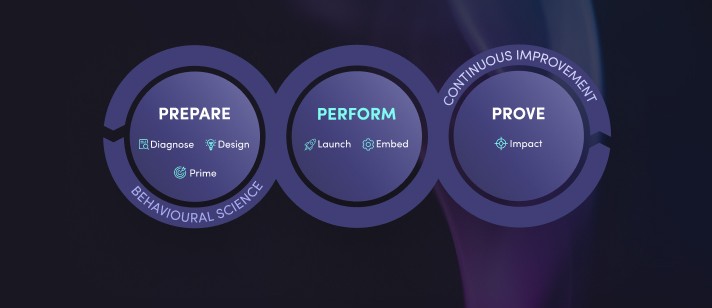
It is the phase in which learning moves beyond planning and begins to shape how people think, decide and act. And yet, this is often where organisational learning begins to lose its hard-earned momentum gained from stage one.
A programme launches well: learners engage, modules are completed, progress is visible. But somewhere between exposure and application, something essential is lost.
Knowledge is absorbed, but not retained.
Concepts are understood, but not applied.
Learning remains separate from the daily pressures and decisions that define performance.
The result is familiar: high levels of participation, but limited behavioural change.
A recent example of this disconnect came from Nationwide Building Society, which was recently fined over £44m for systems and controls failures related to anti-money laundering (AML).
Nationwide had training processes in place, but, as stated in the FCA’s Final Notice, these failed to provide sufficient guidance to staff on how to investigate accounts with potential business use, meaning unusual or suspicious activity went undetected.This is not an uncommon problem.
Organisations have long struggled with what learning specialists call the transfer gap — training is completed, but fails to translate consistently into day-to-day performance across different areas.
The science of learning makes the challenge even clearer: without reinforcement or opportunities to apply new knowledge, much of what people learn can disappear within days.Organisations need to turn learning into stronger decisions, better performance, and measurable impact. In practice, that means learning programmes need to enable sustained engagement, practical application and repeated access to trusted expertise. People develop good judgement when learning becomes active — when they can engage with expertise, apply it in context, test their understanding, and return to it when they need it most. This is the only way to create capability that sticks.
Putting trusted expertise at the heart of effective learning delivery
Trusted expertise sits at the centre of that model. In high-stakes industries, credibility is non-negotiable. We work with practitioners who have operated under the same commercial and regulatory pressures as the teams they teach, allowing them to translate complexity with clarity, connecting technical knowledge directly to practical judgement.
Learning must then be experienced in a way that supports retention and encourages repeated application.
We work in partnership with our clients to align structured pathways with capability gaps and business objectives to help learners progress with purpose, building understanding step by step rather than overwhelming them with disconnected information. Practical scenarios and active assessments reinforce knowledge, and challenge learners to think more critically. Reflection and repetition create familiarity, allowing knowledge to move from something newly acquired to something more instinctive.
A collaborative approach to engagement
Performance is not built in a single interaction. It develops gradually, through consistent engagement and repeated moments of application. We work collaboratively with clients throughout the learning journey to achieve this, using a variety of activities, including workshops, for example, to continually understand and map learning to an organisation’s needs. We also work with clients to ensure learning campaigns are timely and immediately relevant to employees, tying content into global macro trends or specific learning campaigns in areas.
We support our clients to embed continuous learning by heading up communication strategies, including, for example, devising bespoke email campaigns and designing visual assets for learners, tied to where L&D teams want people to focus their learning, and segmenting communications to different internal audiences to boost relevance and engagement.
In this way, we can support L&D teams to develop their influence across the business, helping to raise the perceived value of this essential strategic function at all levels. For our clients, this sustained partnership approach has proved to be one of the most tangible and impactful ways to improve learning engagement and performance.
Technology, and particularly AI, also has a role to play in making that process more effective.
This reinforces our ethos: volume is often the enemy of retention. Learners do not need endless content. They need timely access to the right expertise, delivered in ways that help them deepen the understanding that underpins effective day-to-day action.
That matters because genuine capability is rarely built through isolated interventions. It is built through learning ecosystems.
The most successful organisations do not treat learning as a standalone event. They create environments in which trusted expertise can be accessed repeatedly, integrated naturally into working life, and aligned closely with strategic priorities.
In action: The partnership approach to learning
We see the power of this most clearly when learning becomes a strategic asset in its own right. Our partnership with CMS offers a compelling example of this. As one of the world’s leading legal firms, CMS faced a dual challenge: reinforcing deep legal expertise while building sustainability fluency across a global organisation.
The firm wanted to go beyond compliance, to ensure ESG capability became part of how it advises clients, makes decisions, and defines competitive advantage. The solution was a learning ecosystem designed to build shared capability at scale.
Curated pathways ensured that learning was directly relevant to different teams and roles, helping individuals connect new knowledge to the realities of their day-to-day work. At the same time, the programme was opened to the wider organisation — from legal specialists to support functions — so that sustainability could become a common language across the firm.
Perhaps most powerfully, CMS’s own lawyers became part of the learning experience.
We filmed their experts creating their own content on topics ranging from environmental regulation to modern slavery and sustainable finance. Their practical insights enriched the programme, but their direct input also did something more important: it created trust, relevance and ownership. Learning became an extension of the firm’s own expertise and ambitions.
Engagement was entirely voluntary, yet participation exceeded expectations, with 127 CMS expert content hours viewed, and an average CMS content rating of five out of five. This showed that when learning is authoritative, relevant and deeply connected to professional identity, people choose to engage.
This is what Perform looks like: learning embedded deeply enough to strengthen confidence, shape judgement and help organisations move from capability-building to capability in action. This can mean different approaches depending on the organisation, for example:
- Learning pathways aligned to specific roles and capabilities.
- Bespoke expert-led content built around their unique commercial or regulatory challenges.
- Or, increasingly, fully tailored learning academies: strategic capability platforms built to support execution over time, and eliminating the need for static content libraries that have failed to evolve for complex learning needs.
Perform is the phase where trusted expertise begins to move, where learning shifts from consumption to application, and where confidence grows quietly into judgement.
It is where capability begins to influence decisions, behaviours and outcomes in ways that organisations can feel, even before they can fully measure them.
Preparation creates readiness, Perform creates momentum. It is where learning becomes embedded deeply enough to shape how work gets done.

xUnlocked
Share "Perform: Turning trusted expertise into capability" on
Latest Insights

El Niño: Everyone is talking about it. But what does it actually mean for your business?
1st October 2026 • Maria Coronado Robles